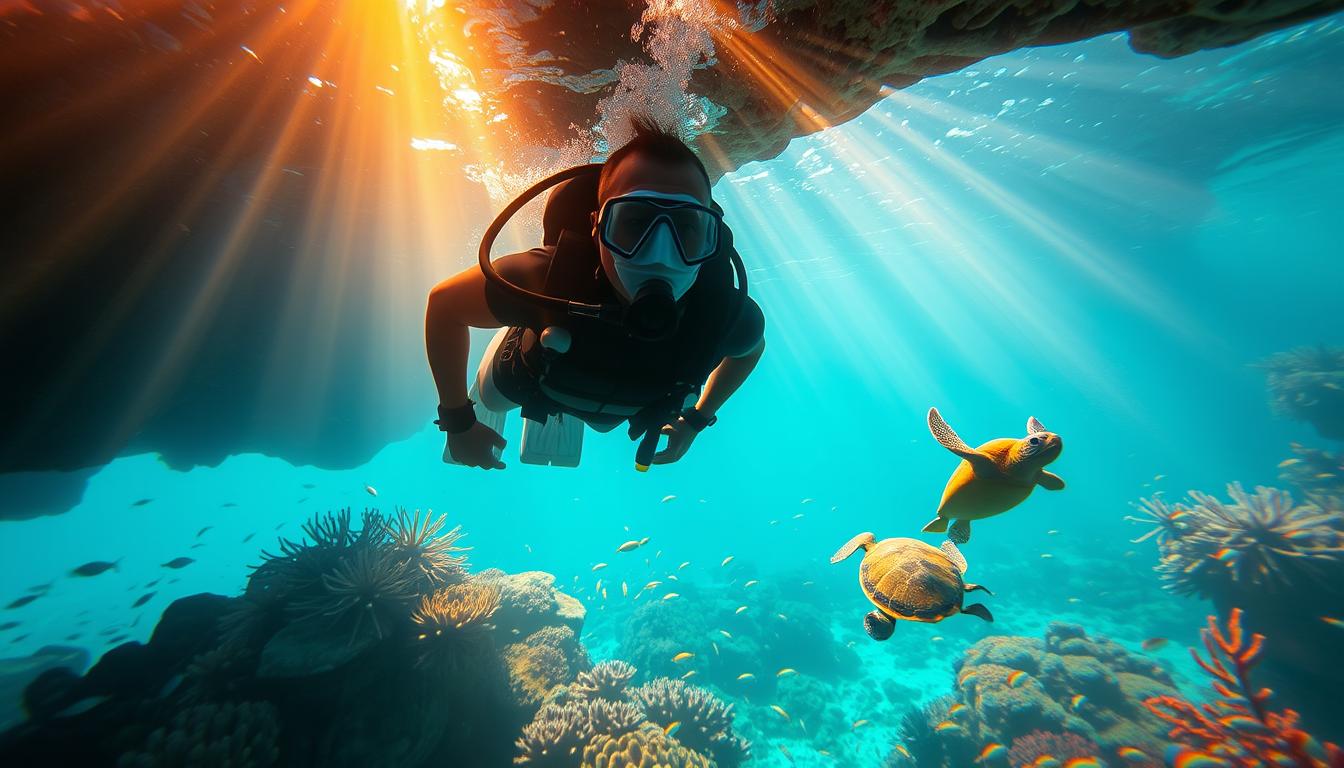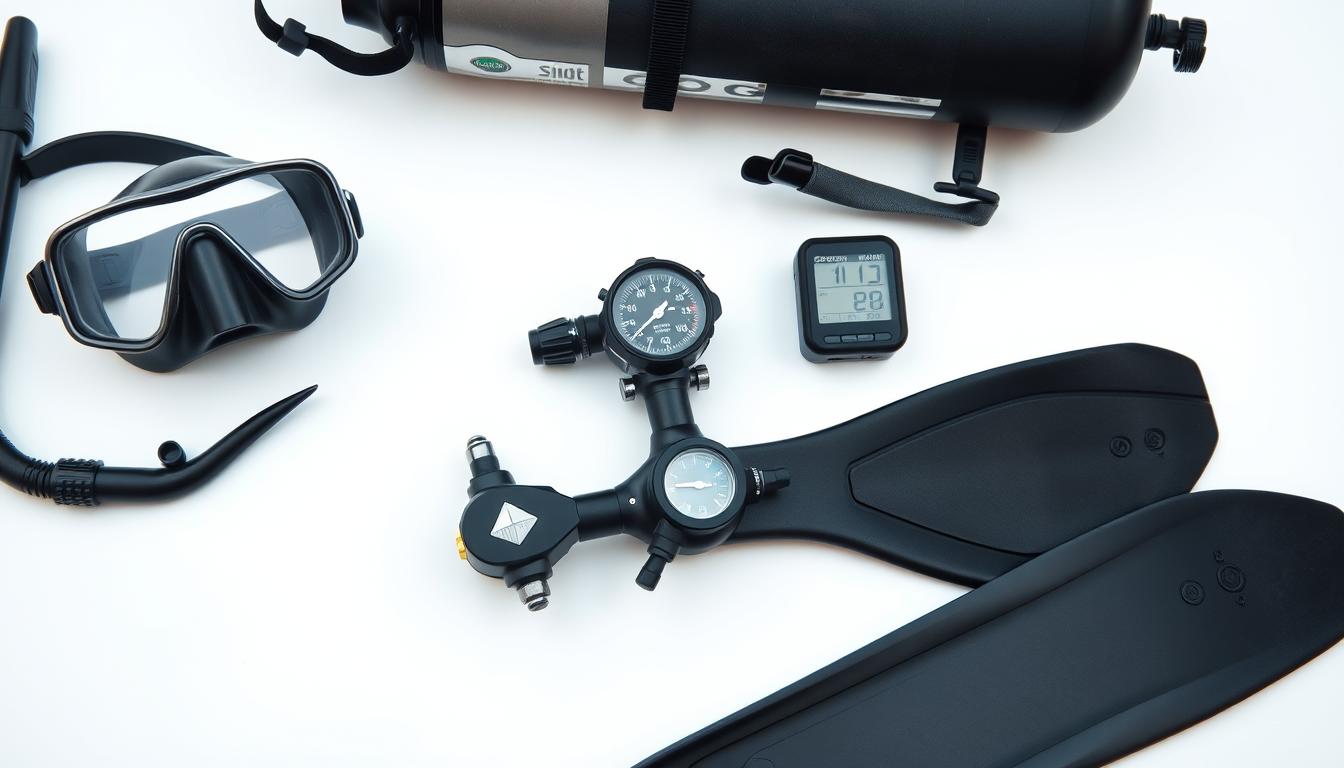
Getting ready for a scuba dive needs careful planning. You must have a complete list to not forget anything. Whether you are new or skilled in diving, the right gear is key for your safety and fun. This checklist will help you pack, ensuring you miss nothing.
Key Takeaways
- Carry essential documents such as certification cards, DAN membership, and travel insurance.
- Ensure you have basic gear essentials like mask, snorkel, and fins.
- Include a buoyancy control device (BCD) to ensure proper buoyancy underwater.
- Pack regulators and air supply equipment including primary and alternate second stage regulators.
- Don appropriate exposure protection gear like wetsuits, drysuits, gloves, and booties.
- Use dive computers and instruments to monitor depth, time, and direction underwater.
- Always carry weights and weight systems for proper buoyancy management.
- Include lights and signaling devices for visibility and safety.
- Bring necessary cutting tools like dive knives and shears for emergencies.
Essential Documents and Preparations
Getting ready for a dive means having all the key papers and plans. This list is as important as your diving gear. It helps your dive go smoothly without any stress.
Certification Card (C-card)
Your Certification Card, or C-card, is a must-have. It shows you’re trained and can safely dive. It lets you rent gear and join groups. Don’t forget it to keep diving trouble-free.
DAN Membership Card
A DAN Membership Card is key for your dive trips. It gives you emergency medical help made for divers. Always keep this card with you.
Travel Insurance
Travel insurance is vital for your dive list. It covers unexpected problems like cancellations and lost bags. It even pays for dive accident care. It keeps your adventure safe.
Basic Gear Essentials
It’s important to have the right gear for a fun and safe diving trip. Make sure your scuba diving list has all you need to explore under water. Your must-have items should include a mask, snorkel, and fins. These are dive gear essentials.
Mask
The mask is super important for diving. It should fit well so you can see clearly under water. This helps you spot fish and find your way. A good fit keeps water out and makes your dive better.
Snorkel
Don’t forget your snorkel on your list. It helps you save air when you’re floating before diving deeper. Look for one that’s easy to breathe through and feels good in your mouth.
Fins
Fins are key for moving smoothly and fast in the water. They help you swim without getting too tired. Choose fins that you can adjust and that feel comfy on your feet. They make diving a lot better.
| Item | Importance | Consideration |
|---|---|---|
| Mask | High | Snug fit, clear vision |
| Snorkel | Medium | Conserves air, comfort |
| Fins | High | Boosts mobility, saves energy |
Buoyancy Control Device (BCD)
The Buoyancy Control Device (BCD) is an essential scuba equipment for divers. It helps you stay stable and in control under the water. It makes diving comfortable and safe.
A good BCD does more than just help you float right. It also holds your tanks and other important gear. It’s a key part of your scuba gear checklist for any dive.
Let’s look at what makes a great BCD compared to an okay one:
| Feature | Excellent BCD | Average BCD |
|---|---|---|
| Adjustability | Highly adjustable with multiple strap adjustments for a secure fit | Limited adjustability, fewer strap options |
| Inflation and Deflation | Quick and easy with responsive controls | Slow and less responsive, harder to fine-tune |
| Weight Integration | Convenient, integrated weight pockets | Basic, with manual weight belts |
Having a dependable BCD in your scuba gear checklist is key. It boosts your control and makes your dive safer and more fun.
Regulators and Air Supply
Regulators let divers breathe easily under the water. They are key to dive gear. They supply air safely for fun dives. Knowing about scuba diving regulators is key for divers.
Primary Second Stage
The main part is the primary second stage regulator. It takes air from the tank to the diver. It changes the air pressure so breathing underwater feels normal. A top-notch primary second is a must for good performance.
Alternate Second Stage
An alternate second stage has a bright color to spot easily. It’s there for sharing air in emergencies. Keeping it well-maintained is critical for safety.
Octopus
The octopus is an extra backup regulator. It’s put where you can get to it quickly. It adds safety if the other parts don’t work right. Checking it often and storing it right keeps it working well.
Exposure Protection
Divers need exposure protection gear to handle the tough underwater world. The right thermal protection diving gear, like wetsuits and drysuits, keeps you safe and comfy. Gloves, hoods, and booties also protect you, making them key scuba gear essentials.
Wetsuits and Drysuits
It’s key to know the difference between wetsuits and drysuits for diving suit requirements. Wetsuits trap a thin layer of water that gets warm from your body heat. Drysuits keep you dry and are better for cold water. Both are important for thermal protection diving.
Gloves, Hoods, and Booties
To really stay warm while diving, you need gloves, hoods, and booties. They keep your hands, head, neck, and feet safe from the cold and dangers underwater. Gloves protect your hands, hoods cover your head and neck, and booties keep your feet safe.
Undergarments for Drysuits
If you dive in cold waters, you’ll need undergarments under your drysuit. These come in different thicknesses and materials to match diving conditions and what feels good for you. Picking the right ones is key to stay warm, making them top scuba gear essentials for cold-water diving.
Dive Computers and Instruments
Modern diving needs advanced equipment for a safe underwater experience. These tools are key for checking depth, direction, and dive time. Let’s explore these important instruments.
Dive Computers
Dive computers are key for divers. They give real-time depth, dive time, and decompression info. They’re vital for avoiding decompression sickness by watching nitrogen in the body.
Depth Gauge
The depth gauge is crucial for high-tech diving gear. It lets divers know their depth. This helps them stay safe and manage how they float. Knowing the exact depth is key for a safe going up and down.
Compass
A compass is important for precise underwater direction. It helps when looking at wrecks or coral reefs. A good compass keeps divers on track, so they don’t lose their way.
Watch
Even with a dive computer, a waterproof watch is a good backup. It can handle deep water and tells time well. This is needed for keeping track of dive time and safety stops.
Here is a quick comparison of the dive instruments:
| Instrument | Functionality |
|---|---|
| Dive Computer | Tracks depth, dive time, nitrogen levels, and decompression status |
| Depth Gauge | Monitors current depth to ensure safe ascents and descents |
| Compass | Assists in underwater navigation to maintain bearings |
| Watch | Serves as a backup for tracking dive time |
Weights and Weight Systems
Having the right scuba weights and weight systems for diving is key to stay balanced underwater. Without this balance, you might have trouble going down or come up too fast. You might also use more energy. Always check your dive gear checklist for your weight needs.
When picking your scuba weights, look at all the choices:
- Weight Belts: They are traditional, simple to adjust and use. You can change the lead weights as needed.
- Integrated Weights: These fit right into your Buoyancy Control Device (BCD). They are comfy and handy.
Both types have good and bad sides. It really depends on what you like and how you dive. Below is a side-by-side to help you choose:
| Feature | Weight Belts | Integrated Weights |
|---|---|---|
| Adjustability | Highly Adjustable – Easy to add or remove weights | Moderately Adjustable – Limited by BCD capacity |
| Comfort | Can be uncomfortable if not positioned correctly | More comfortable – Evenly distributes weight |
| Ease of Use | Simple to use – Requires a belt to wear around the waist | Convenient – Part of the BCD, no extra belt required |
Always aim for a balanced and comfy dive. Regularly check your dive gear checklist. Make sure your weight systems for diving are perfect.
Lights and Signaling Devices
Dive safety gear helps you have a safe and fun time under water. Divers need good lights and ways to talk underwater. It doesn’t matter if it’s day, night, or if the water is murky. Good lights and signals make diving much safer. They help divers see around, talk to their team, and ask for help if they need to.

Dive Lights
Dive lights light up the water for divers. They help see marine life and undersea things better. Good dive lights work well in all types of water. They give off strong and steady light. Having good dive lights makes diving much better.
Surface Marker Buoys
Surface marker buoys are important for talking while diving. They make sure divers can be seen by boats. They float on the water and show where the diver is. They also send safety and help signals. A good buoy is important for keeping divers safe and easy to find.
Whistle
A whistle is very important but often forgotten. It is great for talking and sending help signals in emergencies. It’s light and easy to carry. Every diver should have a whistle to keep them safe.
Cutting Tools
When diving, it’s really important to have the right cutting tools. These tools give you peace of mind and are key in emergencies. There are many types of scuba safety equipment for different dangers. The main cutting tools are:
Dive Knives
Dive knives are must-have tools for many tasks. They cut through things like fishing lines, nets, and seaweed. If you’re in thick kelp, get a knife with a serrated edge. For places with lots of fishing lines, choose one with a line cutter or scissors. Titanium knives are lighter and don’t rust easily but cost more than steel ones.
| Feature | Stainless Steel | Titanium |
|---|---|---|
| Edge Retention | Excellent | Good |
| Corrosion Resistance | Requires Maintenance | High Corrosion Resistance |
| Price | Affordable | 30-50% More Expensive |
Shears
Shears, or sea snips, are vital tools, too. They are great for cutting thick materials and freeing tangled lines. Some divers choose shears for their precision and for handling different cutting jobs better than knives.
Diving knives and shears are key parts of your scuba safety gear. Keep them clean with fresh water and dry after use. This maintains their quality and makes sure they work well under water.
“Save-A-Dive” Kit and Spare Parts
A “Save-A-Dive” kit is very important for a well-prepared diver. It helps you deal with surprise problems during a dive. With items like O-ring kits, extra mask straps, and multi-tools, you can fix small issues quickly. These can keep a small problem from ruining your dive.
O-ring Kit
The O-ring kit is key in your scuba repair kit. O-rings keep your diving gear airtight, like your breathing system. If O-rings fail, you could lose air. Make sure you have many sizes of O-rings for different gear.
Mask Straps and Fin Buckles
Mask straps and fin buckles are very important too. They can wear out, so having extras is smart. If they break, you could end your dive early. But, with spares, you can keep diving with no problems.
Multi-tool
You really should have a multi-tool in your dive kit. It lets you do small repairs quickly. A multi-tool can tighten screws and cut lines. Make sure it has pliers, screwdrivers, and knives to help with many things.
Scuba Gear Checklist for Specific Dives
When planning your *scuba gear*, it’s key to match it to your dive conditions. Different dives need different gear for safety and comfort underwater.
Tropical dives often need just light wetsuits or dive skins. You might also want smaller dive lights and thin gloves.
Cold water dives require different gear. You’ll need thick wetsuits or drysuits, plus undergarments, hoods, gloves, and booties. This gear keeps you warm in cold water.
Wreck diving adds more needs to your *scuba gear planning*. You should take penetration reels, extra lights, and cutting tools. These help you move around and explore wrecks safely.
| Dive Type | Recommended Gear |
|---|---|
| Tropical | Lightweight wetsuits, compact dive lights, thin gloves |
| Cold Water | Thick wetsuits or drysuits, undergarments, hoods, gloves, booties |
| Wreck | Penetration reels, additional lighting, cutting tools |
Good *scuba gear planning* for your dive type makes your underwater trip safe and fun. Check the dive conditions and choose your gear wisely. This will help you enjoy your dive adventures more.
Personal Comfort and Safety Items
Diver health and safety are very important. Adding personal diving items makes diving more fun. They also keep you safe under the water and above it. Here are some key items every diver needs.
Nutritional Snacks
It’s important to keep your energy up when diving. Eating things like protein bars and nuts helps a lot. Having these personal diving essentials with you can really help keep your energy and focus.
Sunscreen
It’s important to protect your skin from harmful sun rays. Use sunscreen that’s safe for reefs so you don’t harm ocean life. Putting on sunscreen before and after dives helps keep your skin healthy.
Water Bottle
Being hydrated is key for your health and safety. Always have a reusable water bottle with you. Being hydrated helps you to dive better and stay well.
First-aid Kit
A first-aid kit is a must-have. It gets you ready for small injuries or emergencies. Make sure your kit has things like bandages and pain relievers.
For more about scuba comfort items, snacks, and others, check this packing guide.
| Item | Use | Importance |
|---|---|---|
| Nutritional Snacks | Energy Boost | High |
| Reef-safe Sunscreen | Skin Protection | High |
| Reusable Water Bottle | Hydration | Essential |
| First-aid Kit | Medical Emergencies | Critical |
Conclusion
Getting ready for a scuba dive needs careful planning. It’s important to have all you need on a scuba checklist. You should pack everything from your certification card and diving insurance, to snacks and sunscreen.
In our diving gear guide, we talked about many types of equipment. We covered masks, regulators, dive computers, and how to stay warm underwater. Every item is chosen for a certain reason, like keeping you safe and comfy.
Having a “save-a-dive” kit with extra parts is also crucial. It helps you fix problems quickly.
The key to a good dive is making a checklist that fits you. It doesn’t matter if you’re new or have dived a lot. Knowing and having the right gear makes diving worry-free and fun.